How to Increase Your Operating Room Nurse Salary: Certifications, Skills and Career Moves

See if you qualify for training programs
Answer a few questions in 2 minutes. Free, no commitment.
Raising an operating room nurse salary comes down to three moves: earning a credential such as the CNOR, adding the skills surgical teams pay extra for, and changing roles or employers when the numbers justify it. OR nurses, also called perioperative or surgical nurses, start from the registered nurse pay scale, which had a median of $97,550 a year in May 2025, according to the Bureau of Labor Statistics (BLS). BLS doesn't track OR nurses separately, so that figure covers all RNs.
What you add from there is where the gaps open up. AORN's 2024 salary survey found staff perioperative nurses averaged $89,200 while nurses in director and vice president-level roles averaged $135,600, and registered nurse first assistants (RNFAs) average $113,214 on ZipRecruiter. The CNOR that unlocks the RNFA path and shortens the route to leadership credentials requires two years and 2,400 hours in the OR, so the timeline starts the day you're hired.
Travel Operating Room Nurse Salary
Travel contracts pay the most per week. The average travel operating room nurse earns $2,442 a week as of October 2026, and $2,954 a week in California, according to Vivian. AORN's 2023 survey found travel nurses earned $18,100 more a year than staff nurses.
Those weekly figures usually include tax-free stipends rather than taxable wages alone, so the trade-off is stability and a more complicated paycheck. Our guide to travel nurse pay explains how the packages are built.
Changing Employers and Settings
The same OR job pays differently depending on who runs the building. Hospitals pay RNs a $100,220 median, compared with $91,230 in ambulatory health care, according to BLS, though AORN's 2022 survey found that pay at freestanding surgery centers roughly matched hospital pay for perioperative nurses.
Public employers publish their differentials, which makes them easy to compare:
- The Department of Veterans Affairs pays nurses 10% extra for night shifts, 25% for weekends and double time on holidays, with on-call pay set at 10% of the overtime rate, under federal law. A VA operating room nurse posting in Hampton, Virginia, listed $83,487 to $153,496 a year in September 2026.
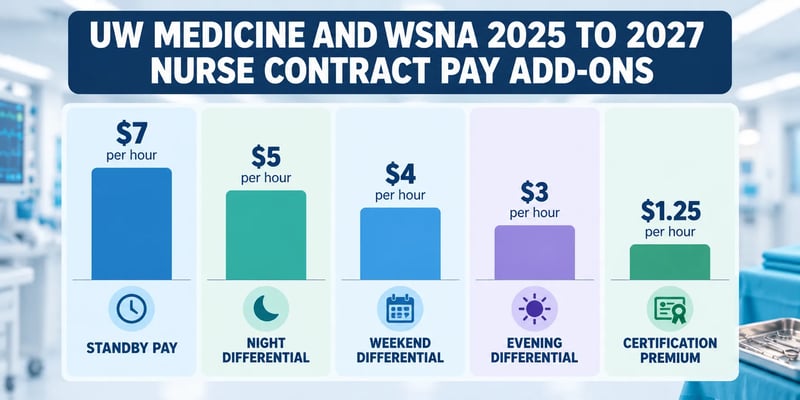
- The UW Medicine and WSNA contract for 2025 to 2027 pays $7 an hour on standby, a three-hour minimum at time and a half when called back, $3 for evenings, $5 for nights and $4 for weekends.
- San Mateo County, California, pays on-call nurses half their base hourly rate while on standby, with a three-hour overtime minimum per callback, under its 2022 to 2025 nurses' labor agreement.
The RNFA and the CSSL both require a bachelor's degree. Dreambound brings nursing programs from different schools together in one place, so if you hold an associate degree, you can compare BSN programs, including RN-to-BSN options, by format and length before you commit.
Negotiation Tips for Operating Room Nurses
Perioperative nurses have more to negotiate than base pay, and the data above gives you a starting point for each item:
- Get the range before the conversation. California requires every employer to give applicants the pay scale on request, and employers with 15 or more employees must include it in job postings. Washington's law covers employers with 15 or more employees, according to the state's Department of Labor and Industries, New York's covers employers with four or more, according to the New York Department of Labor, and Colorado's applies to any employer with a Colorado employee. In other states, ask for the range anyway.
- Negotiate the extras. Call pay, callback minimums, shift differentials, certification premiums and preceptor pay are all line items. AORN's 2025 analysis found that call pay was a source of dissatisfaction and that benefits such as 401(k) matches and tuition reimbursement had eroded since 2024, which makes them fair targets.
- Ask about a hiring bonus when you switch. In AORN's 2024 survey, 22% of perioperative nurses received a hiring bonus, and 63% of those bonuses were $10,000 or more. The share fell to 16% in 2025, so bonuses are available but no longer automatic.
- Time your ask to a credential. The two-year CNOR mark and RNFA completion are natural moments to renegotiate, and AORN's 2025 analysis found pay rises faster early in a perioperative career than later.
- Read the contract if you're in a union. Union members in health care practitioner and technical occupations earned median weekly pay of $1,605 in 2025, compared with $1,521 for nonunion workers, according to the BLS union membership release. Contract pay schedules, like the UW Medicine example above, spell out every differential in writing.
- Know how your overtime is calculated. Under federal rules, hospitals can use a 14-day "8 and 80" schedule that pays overtime after eight hours in a day or 80 in two weeks, but only with a prior agreement, so ask which system your employer uses before you take extra shifts.
Frequently Asked Questions
Is it hard to become an operating room nurse?
There's no separate license for the OR, but the specialty has its own training path. You first need an RN license through an associate or bachelor's degree program and the NCLEX-RN exam, then a perioperative orientation program, which CCI requires for its CFPN credential. The CFPN is available within your first 23 months, and the CNOR follows at the two-year, 2,400-hour mark. Our guide on how to become a registered nurse covers the licensing steps.
Where do operating room nurses make the most money?
California, where RNs earned a $140,270 median in May 2025 and the San Jose metro area reached $216,740, according to BLS data. AORN's 2022 and 2025 surveys both found the Pacific region paying above the national average for perioperative nurses, and Nurse.com's 2026 report found a $100,000 median RN salary in the West compared with $80,000 in the Midwest and South.
What does an operating room nurse do?
Operating room nurses care for patients before, during and after surgery. Broadly, circulating nurses manage the room, verify consent and counts, monitor the patient and document the case, while scrub nurses maintain the sterile field and pass instruments, and RNFAs assist the surgeon directly. Our comparison of registered nurses and surgical technicians explains how the nurse's role differs from the surgical technologist who works beside them.
Can you make $200,000 as a nurse?
Yes, in a few places and roles. The top 10% of California RNs earned more than $213,320 in May 2025, and the San Jose metro median was $216,740, according to BLS. Outside the Bay Area, the surest path is advanced practice: nurse anesthetists earned a median of $236,590 in May 2025, and perioperative leaders averaged $135,600 in AORN's 2024 survey.
Building Your Operating Room Nurse Pay Plan
The order of the moves matters more than any single one. The CNOR comes first because the RNFA requires it and it halves the experience the CSSL asks for, and its two-year clock starts on your first day in the OR. From there, pick the path that fits: first assisting for the biggest bedside raise, leadership for the highest ceiling, travel for the fastest weekly pay, or a public employer whose differentials are written into law.
Whichever you choose, walk into the negotiation with the posted range, the contract schedule and your credentials in hand.
If a bachelor's degree is the step between you and those roles, Dreambound lets you compare RN-to-BSN programs by format and length in one place.